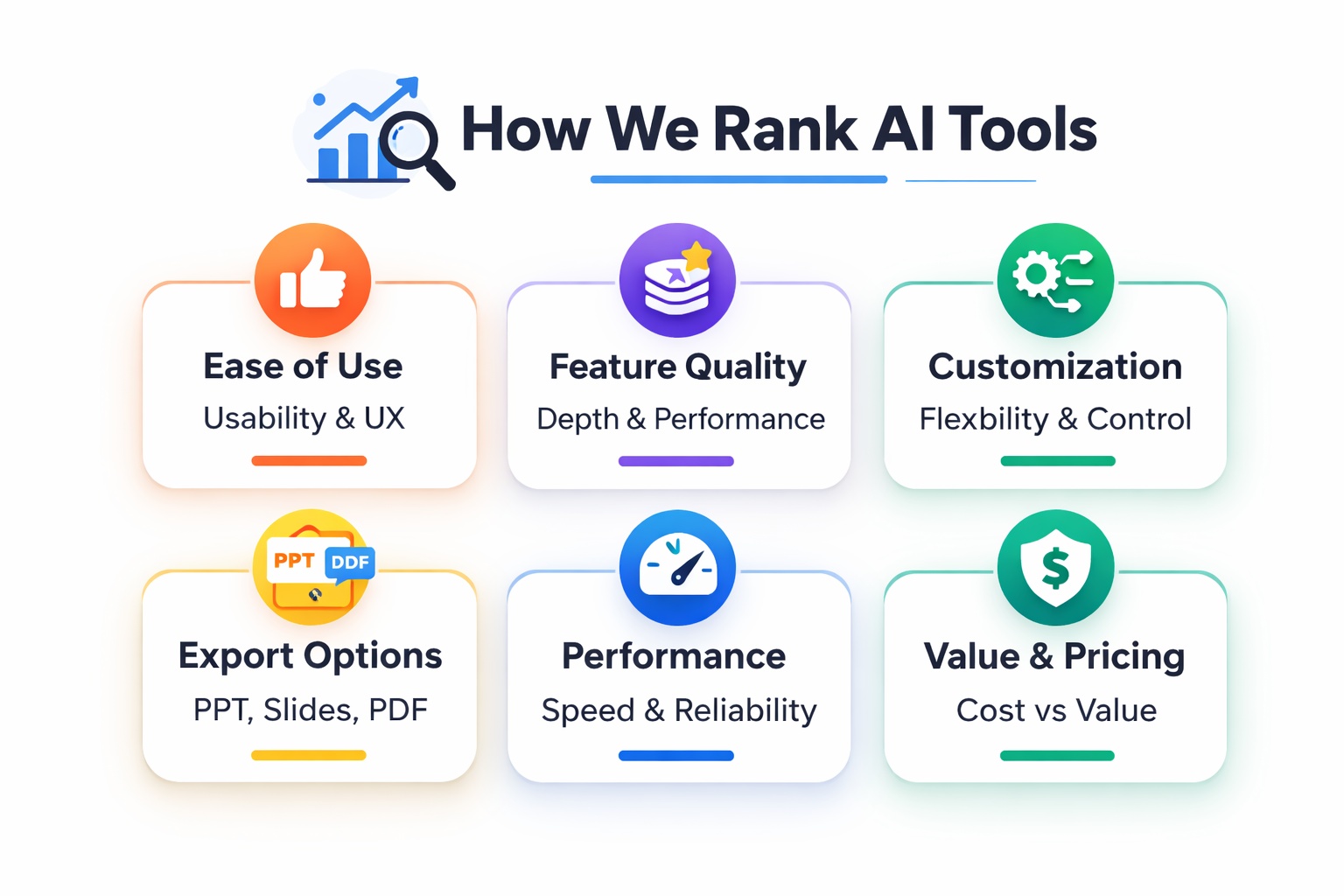
Choosing the right AI tool isn’t easy. New platforms launch every week, features change constantly, and pricing structures shift without warning. At TopAIToolRank, we use a structured and transparent evaluation framework to rank AI tools based on real-world usefulness — not hype.
This page explains how we rank AI tools, what factors influence rankings, and how often we update our evaluations so you can trust what you’re reading and make faster decisions.
Quick answer
We rank AI tools using a transparent scoring framework: usability, feature depth, pricing transparency, performance, real-world workflow fit, and product direction. We adjust weighting by category (writing, video, sales, productivity, research) so comparisons match how tools are used in practice. Rankings update when tools change features, pricing, or reliability.
Key takeaways
- We rank tools for practical use, not marketing claims or popularity.
- Usability, pricing transparency, and workflow fit carry significant weight.
- Category-specific weighting prevents “one-size-fits-all” rankings.
- Affiliate links (when present) do not influence ranking order.
- Rankings are reviewed and updated when products change materially.
TL;DR
We rank AI tools using consistent criteria and category-specific weighting, with clear rules to keep rankings fair, practical, and trustworthy.
Why trust matters in AI tool rankings
The AI industry moves fast. Tools get funded, promoted aggressively, and marketed as “revolutionary” — but not all of them deliver practical value.
We built TopAIToolRank around one principle: rank tools the way real professionals evaluate software. That means focusing on usability, performance, pricing fairness, and practical workflow impact.
Our AI tool ranking criteria
Our AI tool ranking criteria are consistent across categories, with category-specific weighting where needed. Every tool is evaluated across the dimensions below.
1) Usability & user experience
We assess how easy it is to start using the tool, understand the interface, and fit it into daily workflows. Tools with lower friction and clearer UX generally score higher.
2) Feature depth & capability
We evaluate feature breadth, customization depth, output consistency, handling of edge cases, and how well the tool scales from individual use to team workflows.
3) Pricing transparency & value
We look for clear plans, fair tiering, and pricing that matches value. We don’t automatically rank cheaper tools higher — the question is whether the cost is justified for the outcomes.
4) Real-world application
A tool should solve real problems: messy inputs, unclear requirements, repeated iterations, and shared team usage. If something demos well but breaks in real workflows, its ranking reflects that.
5) Performance & reliability
Performance includes speed, stability, consistency, downtime frequency, and API reliability (when relevant). A serious tool needs to be dependable.
6) Innovation & product direction
AI changes fast, so we consider update frequency, roadmap clarity, responsiveness to user needs, and long-term sustainability.
Category-specific ranking adjustments
Not all AI tools are judged the same way. We adjust weighting depending on category so comparisons reflect how tools are actually used.
| Category | Higher weight criteria |
|---|---|
| AI Writing Tools | Output quality, tone control, long-form stability |
| AI Video Tools | Rendering speed, editing flexibility, export quality |
| AI Sales Tools | CRM integration, automation reliability, workflow impact |
| AI Productivity Tools | Task automation, workflow optimization, scheduling intelligence |
| AI Research Tools | Accuracy, citation handling, summarization quality |
Examples: you can explore categories like AI Writing Tools and AI Productivity Tools to see how criteria show up in real rankings.
How our ranking process works
Our process is structured so rankings remain consistent across categories and over time:
- Define the category scope and intended use cases
- Identify relevant tools with meaningful features
- Evaluate each tool against the core criteria
- Apply category-specific weighting
- Compare relative strengths and trade-offs
- Update rankings when meaningful product changes occur
If you’re searching for how we rank AI tools, this framework is the exact process we follow to keep rankings fair and practical.
Comparison summary table (evaluation framework)
This is the simplified scoring view we use to keep evaluations consistent.
| Evaluation area | What we measure | Why it matters |
|---|---|---|
| Usability | Onboarding, navigation, learning curve | Faster adoption, less friction |
| Features | Depth, customization, reliability | Capability across real workflows |
| Pricing | Transparency, tier fairness, value alignment | Fair cost-to-benefit ratio |
| Performance | Speed, uptime, consistency | Dependability in production use |
| Real-world fit | Practical application in common scenarios | Actual productivity impact |
| Innovation | Update frequency, roadmap clarity | Long-term viability |
What we do not consider
To maintain neutrality, we do not rank tools based on market share claims, funding announcements, social media buzz, or affiliate commission potential.
Editorial policy
- We do not accept payment for ranking placement.
- We separate editorial evaluation from monetization.
- We update pages when meaningful changes occur.
- We correct mistakes quickly when reported.
Affiliate transparency
Some pages may contain affiliate links. If you choose to purchase through those links, we may earn a commission. However, affiliate relationships do not influence ranking order. Tools cannot pay for higher rankings or preferred placement.
How often rankings are updated
We update rankings when major feature updates occur, pricing changes significantly, reliability improves or declines, or when new competitors materially change the category. We also perform periodic reviews to keep comparisons accurate.
Last updated: 24 Feb 2026
Next review: Updated when tools or pricing materially change
FAQ
How do you rank AI tools?
We rank AI tools using a consistent framework: usability, feature depth, pricing transparency, real-world application, performance and reliability, and product direction. Rankings are comparative within each category and may change as tools evolve.
Do companies pay to be ranked higher?
No. Tools cannot pay for higher rankings or preferred placement. Sponsorships and affiliate relationships do not influence ranking order.
How often are rankings updated?
We update rankings when major feature releases, pricing changes, performance shifts, or new competitive tools materially affect a category. We also do periodic reviews to keep pages current.
Do you use affiliate links?
Some pages include affiliate links. If you buy through those links we may earn a commission, but affiliate relationships do not affect rankings. We prioritize transparency and long-term trust.
Why might a popular AI tool rank lower?
Popularity does not always match real-world usefulness. Some tools are heavily marketed but may have weaker usability, unclear pricing, inconsistent output, or limited workflow fit compared to alternatives.
Do you test every AI tool?
We evaluate tools using structured criteria, product capabilities, usability review, workflow fit, reliability signals, and documented updates. Rankings are comparative and designed to help you shortlist tools for your needs.
Contact for corrections
If you spot an error, outdated pricing, or a broken link, contact us via /contact.html and we’ll review it.
Related reading
This methodology page is designed to be a trust page — clear, practical, and transparent. If you want to explore side-by-side pages, you can link this to your upcoming comparisons hub.